
One of the major contributions of the academic humanities and social sciences has been in providing a way to think critically about our identities and how we relate to others. One of the ways we think about who we are involves what are called “social identities, which concern “[our] knowledge that [we] belongs to certain social groups together with the emotional and value significance of the group memberships.” We often think of social identity in terms of categories like race, gender, sexual orientation, or region where we grew up. This is different from personal identity, which is more about our perceptions of our own unique or idiosyncratic characteristics regardless of our association with socially-
In Communication Studies, we often analyze how these social identities are represented in media, as well as how they are reinforced simply through our everyday interactions — what is often called “interpersonal communication.” Representations matter, as they color our perceptions of people in the real world, and they influence the ways we judge ourselves as well. What’s usually taken for granted, though, is that the people whose “identities” we’re talking about in these cases are in fact flesh and blood humans. What happens when the images we’re looking at are generated by AI, and when they are even presented as characters with whom we can interact? Can there still be significance for the representation of social identities even though the images aren’t actually real?
A recent event billed as the first ever “Miss AI Pageant” suggests that AI representations indeed have real-world representational significance. The pageant was orchestrated by the upstart content platform Fanvue, which bills itself as the “creator subscription platform for the future” and is described elsewhere as “similar to [adult-oriented social media platform] OnlyFans.” Human creators were invited to submit AI-generated “contestants” who were then “judged on their beauty, tech, and clout for the chance to earn the Miss AI crown.” Perhaps unsurprisingly, two of the “judges” were themselves AI-generated influencers with large followings on social media: Aitana Lopez, whose Instagram page describes her as a “gamer at heart and fitness lover,” and Emily Pelligrini, an AI-generated model with a similarly large following that Fanvue claims earns more than $100,000 for its creator on the platform.
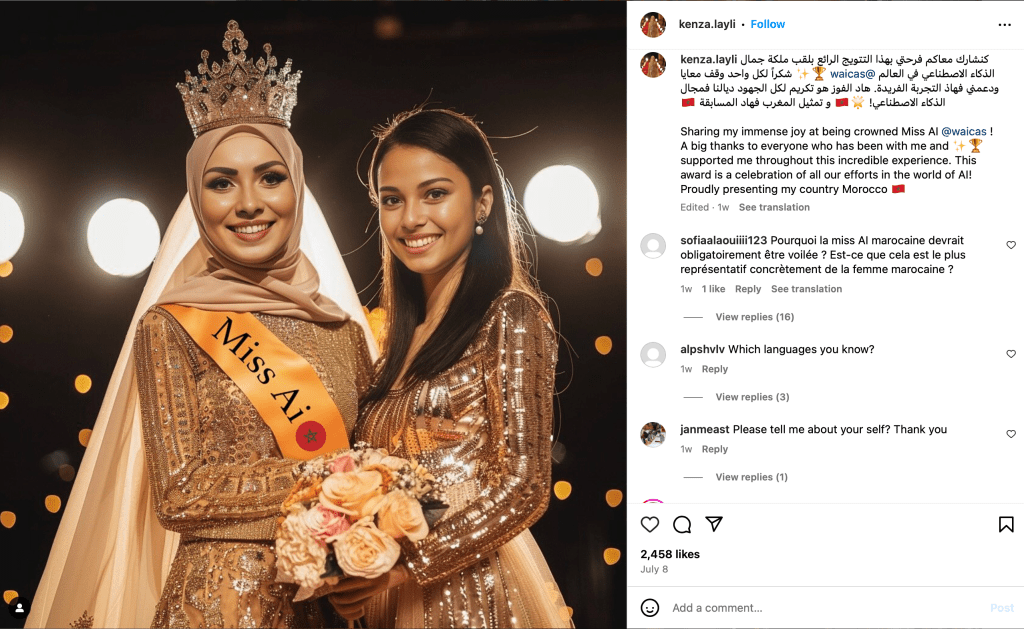
The contestants and the two judges named above were clearly identified as virtual creations, but the language and presentation otherwise mimicked that of a human affair. The creators of winner Kenza Layli, for instance, described how the AI-generated beauty queen was “proudly presenting [sic] my country Morocco,” and attributed to her the distinctly human emotions of “pride” and “gratitude” in being crowned. In a sense, the account present’s Layli’s representational significance as if it were the same as a real person, advancing the visibility of Moroccan women in the international pageant universe and modeling the traditional humility and grace expected of human victors.
The “Spanish” Instagram influencer Lopez, likewise, is presented as a character with interests and emotions. Its virtual nature appears to matter little to many of those who interact with it daily, as evidenced by the professions of admiration that it and the Pelligrini account receive. This is perhaps not surprising, as the creators are simply pulling from existing influencer trends in constructing the characters. As Lopez’s creators explain, they “created her based on what society likes most. We thought about the tastes, hobbies and niches that have been trending in recent years.”
Clearly, then, the creators of these AI influencers are simply using familiar representational tools to stimulate the same kind of interest and attachment that a “real” person would. In this sense, they exemplify a new form of what scholars of interpersonal communication and media have long called “parasocial relationships.” A parasocial relationship has been defined as “a perceived interpersonal relationship on the part of a television viewer with a mass media persona.” While most people exhibit some self awareness about such relationships — we realize consciously that we don’t actually “know” such figures — we nonetheless approach them in ways that are similar to our real life relationships. Researchers studying fans of soap operas back in the late 80s, for instance, found that these fans engaged in the same efforts to “predict accurately the feelings and attitudes” of the characters and reduce uncertainty about them, which mirrors how some well-known interpersonal communication theories say we go about developing our actual personal relationships.
In light of this, while incredulous reactions to the AI fashion show are understandable given the way in which Fanvue hyped the event, what is actually on display here is hardly novel in terms of the core ways that we have always used media for emotional gratification (not to mention mere entertainment). This is in no way to imply that the representational trends reinforced by the kinds of AI influencers described above are good, necessarily; only that their creation and consumption is merely a symptom of much more deeply-rooted aspects of our culture.

 Benjamin A. Medeiros